Artist in Residence
FALL 2026
Teatro del cielo (Ecuador)
In residence Fall Quarter 2026 (September - December 2026)
Teatro del Cielo's residency is co-presented by the Department of Theatre and the Kaplan Humanities Institute.

About the Artists
 Martín Peña Vázquez is a director, playwright, actor, musician, and founding artistic director of Teatro del Cielo. He trained at the International School of Corporeal Mime and Theatre de L’Ange Fou in London, where he completed advanced study in Corporeal Mime and its modern and postmodern repertoire. He is also the author of Raíz y Proyección del Pensamiento Corporal (Foundations and Projection of Corporal Thought). His artistic and pedagogical work has been presented across Latin America, Europe, the Caribbean, the Middle East, and the United States.
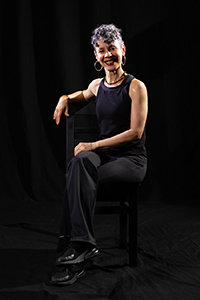 Yanet Gómez Gómez is a Cuban-Ecuadorian actress, performer, educator, and founding member of Teatro del Cielo. A graduate of Cuba’s National School of Arts in Havana, she also trained at the International School of Corporeal Mime and Theatre de L’Ange Fou in London. Her work with Teatro del Cielo brings together theater, movement, voice, and Dramatic Body Art. She has performed and taught across the Americas, Europe, the Caribbean, and the Middle East.
About the Residency
During Fall Quarter 2026, Teatro del Cielo invites Northwestern students, faculty, staff, and community members into a lively encounter with physical theater, Dramatic Corporal Mime, and embodied storytelling. Through a course, workshop, performance, Q&A, and informal reception, the residency offers multiple ways to experience movement as a language for thought, imagination, and theatrical creation.
Residency events
Meet the Artists Reception
Details to be announced!
Join us for a welcoming reception with Teatro del Cielo and learn more about the company’s creative world. This informal gathering offers guests a chance to meet the artists, hear about their residency, and begin a conversation about performance, movement, and international collaboration. Refreshments will be served.
Workshop: Introduction to Dramatic Corporal Mime
Details to be announced!
Open to: Students, faculty, staff, and community members.
This three-hour workshop welcomes participants into the foundations of Dramatic Corporal Mime, a physical theater practice that places the actor’s body at the center of scenic expression. Through guided exercises, participants will explore presence, embodied awareness, physical action, and the idea of the “thinking body.” No previous performance experience is required—only curiosity and a willingness to move
Performance: Honeymoon
Details to be announced!
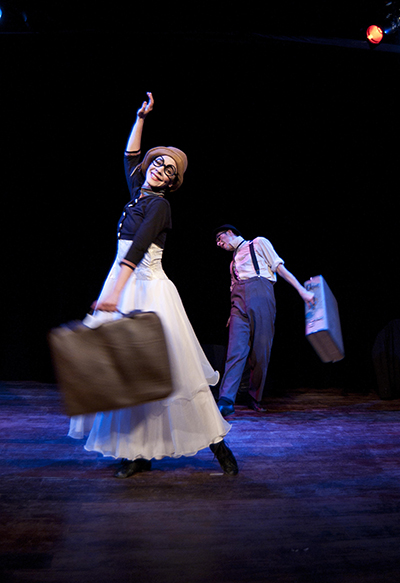
Honeymoon—also known by its Spanish title, Luna de Miel… Lotra de Sal—is a signature work from Teatro del Cielo’s repertoire. The piece follows Lola and Berni, whose union transforms their lives and draws them into a complicated world where the central conflict emerges from their own minds. Together, they begin a journey of no return, moving through changing stages and situations that invite audiences to recognize themselves in the work and to experience, through physical and artistic representation, confusion, joy, absurdity, and madness. Created through Teatro del Cielo’s language of Dramatic Corporal Mime, the work received support from IBERESCENA, the Ibero-American program for the performing arts, and has been presented on international stages. A Q&A will follow the performance, inviting audiences into conversation with the artists.
Fall 2026 Course — THEATRE 240-0-20
Special Topics in Theatre Studies: The Thinking Body: Corporeal Mime in Theory and Practice
Taught by Henry Castillo (Theatre) with Teatro del Cielo. Open to all undergraduate students. No prerequisites. Curious about how movement can become a language for storytelling, thought, and performance? This course invites students of all backgrounds to explore Corporeal Mime through an accessible mix of studio practice, discussion, and creative experimentation. Working with Teatro del Cielo’s internationally recognized approach, students will build practical tools for presence, physical expression, ensemble awareness, and embodied storytelling while discovering new ways to think with and through the body. No previous performance experience is needed—only a willingness to move, observe, and create.
About teatro del cielo
 Teatro del Cielo is an Ecuador-based physical theater company founded in 2004 by Martín Peña Vázquez and Yanet Gómez Gómez. The company develops a theatrical discipline centered on the actor’s body as the primary scenic element, creating symbolic, movement-driven works that expand the possibilities of contemporary performance. Recognized internationally for its distinctive artistic language, Teatro del Cielo is one of the few companies in the world devoted to Dramatic Corporal Mime, a form that embraces the word while grounding its dramaturgy in the expressive power of the body.
Since its founding, the company has presented performances and expanded its pedagogy through theatrical seasons, festivals, workshops, and international gatherings in countries including Chile, Colombia, England, Panama, Uruguay, the Dominican Republic, Spain, Argentina, Costa Rica, Cuba, Qatar, Mexico, the Czech Republic, the United States, Brazil, and Venezuela.
Through performance, pedagogy, and international collaboration, Teatro del Cielo invites audiences and students to encounter theater as a language of embodied imagination. As artists-in-residence, the company brings this rigorous and poetic tradition to Northwestern, opening new spaces for students, scholars, artists, and community members to think, create, and connect through the performing arts.
The Kaplan Institute Artist in Residence Program
The Kaplan Humanities Institute is proud to recognize and financially support working artists across the visual, performing, and literary arts.
Since 2008, Kaplan has co-hosted innovative and award-winning artists working in diverse media, facilitating opportunities to share insight into the conceptualization, process, and production of new work. We have partnered with Northwestern departments and programs to situate artists within a scholarly interdisciplinary community where they share their practice through classes, open studios, screenings, exhibitions, lectures, concerts, readings, and performances.
Building on this longstanding support of arts programming at Northwestern, Kaplan launched a new Artist Engagement Initiative in Spring 2023 with a revamped artist residency program and co-curricular grants.
Questions?
Please contact Jill Mannor at jill.mannor@northwestern.edu.