
Fall 2026 - Class Option #2
A Place Called Home: Great Migrations, Folk Life, and the Chicago Renaissance
This seminar explores the mass movements of Black Americans out of the American South, and into the cities and towns of the East Coast, the Midwest, and the American West, to consider themes of home, community, geography, and the transformations—individual and collective—that are occasioned or obliged by relocating to a new place. “The Great Migration” was in fact a series of migrations of Black southerners that occurred in multiple waves, from roughly 1917 until 1970. And yet across time, their exodus was prompted by common forces, including the acceleration of white southern terrorism, in response to Black advancements in education, political power, and entrepreneurship; the promise of greater freedom and equity outside of the south—especially its rural spaces and places; job opportunities in northern-based wartime factories during World War I and II; and the impact of natural disasters and technological innovations on the agriculturally based economies that remained central to many southern states during these years.
The seminar offers an intensive, interdisciplinary study of literature, music, film, and visual art produced during and about the first and second waves of the Great Migration. We explore the cultural “Renaissances” in destination cities like Chicago and Harlem, and consider the explosion of Black artistic expression as well as the philosophical and cultural critiques offered by the African American intelligentsia of the period. In addition, we examine the migration of Black folklife—faith practices, music, foodways, and vernacular iterations—and chart its impacts across and beyond the US. Finally, the class explores what some sociologists and urban studies scholars have called a “reverse migration,” citing a statistical exodus of African Americans out of the Great Migration’s destination cities in numbers that now rival or exceed the movement itself.
Field excursions will use Chicago and Evanston as sites for connection and exploration and may include local archives like Shorefront Legacy Center—dedicated to preserving the history of Black communities along Chicago’s North Shore—and Chicago organizations and institutions like the Black Metropolis Research Consortium, the Little Black Pearl Community Arts Center, and the DuSable Black History Museum and Education Center. Guest speakers will discuss the architecture of Chicago’s Bronzeville, Southside, and Westside; the social justice artwork and film The Folded Map Project; the South Side Home Movie project; the You Didn’t See Nothin’ podcast; and Chicago Mahogany Tours, among others.
Sample course texts and media
Clarke Hine, Darlene. Black Chicago Renaissance
Griffin, Farrah Jasmine. Who Set You Flowin'
Fisher, Rudolph. The Collected Stories of Rudolph Fisher
Nierenberg, George. Say Amen, Somebody (film, 1982)
Hansberry, Lorraine, A Raisin in the Sun
Stewart, Jacqueline. Migrating to the Movies: Cinema and Black Urban Modernity
Toomer, Jean. Cane
Brooks, Gwendolyn. Bronzeville Boys and Girls
Johnson, Tonika Lewis and Maria Krisan. Don’t Go: Stories of Segregation and How to Disrupt It
King, George. Goin’ to Chicago: Personal Stories of the Great African American Migration (film, 1994)
Wilkerson, Isabel. The Warmth of Other Suns
Morrison, Toni. Song of Solomon & “Rooted: the Ancestor as Foundation”
Charles Burnett. To Sleep with Anger (film, 1990)
Williams, Spencer. The Blood of Jesus (film, 1941)
Baldwin, Davarian. Chicago’s New Negroes: Modernity, the Great Migration, and Black Urban Life
Petty, Audrey. High-Rise Stories: Voices From Chicago Public Housing
Coogler, Ryan. Sinners (film, 2025)
Stahl, John. Imitation of Life (film, 1934)
Scarborough William et al, Between the Great Migration and Growing Exodus: The Future of Black Chicago?
Instructors
Tracy Vaughn-Manley, Assistant Professor, Black Studies; Charles Deering McCormick Distinguished Professor of Instruction
Miriam J. Petty, Associate Professor, Radio/Television/Film
Both Professor Petty and Professor Vaughn-Manley are Charles Deering McCormick Distinguished Faculty of Northwestern.
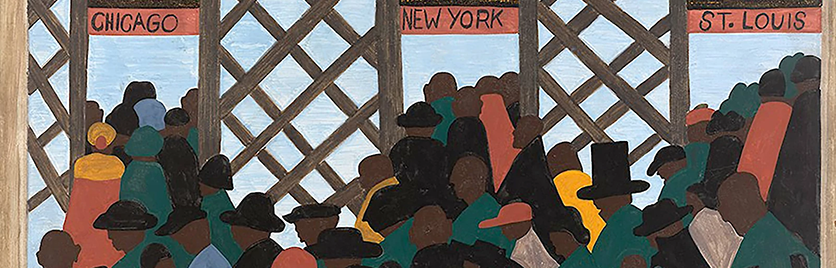
Image at top: Detail from The Migration Series, Panel No. 1: During World War I There Was A Great Migration North By Southern African Americans. Jacob Lawrence, 1940-41.