Fall 2026 - Class Option #3
ISLANDS
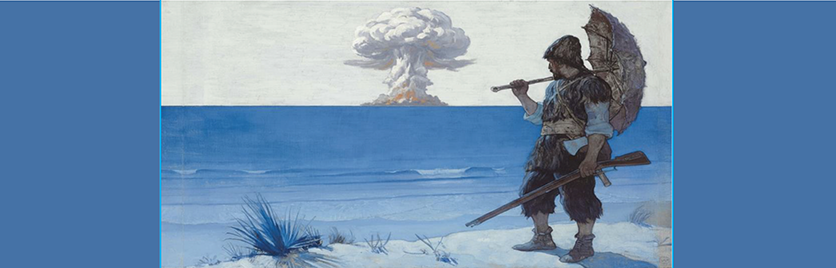
Islands loom large in the imagination. A large body of influential writing, painting, and dreaming about islands has accompanied—and even preceded—encounters with them. In this exciting course, we’ll look at islands across periods and places to explore their crucial role in our understanding of the world. Rather than treating them as isolated spaces, outside of historical currents, we’ll see them as places where the phenomena of modernity are amplified. Islands, in this understanding, are ideal sites for the study of capitalism, slavery, revolution, colonialism, cultural encounters, nationalism, and climate change.
Over the course of the quarter, we’ll look at a diverse and fascinating set of materials. We’ll discuss a play by Shakespeare, attend a Chicago theatre performance, visit Chicago's Art Institute to examine paintings by Paul Gauguin, analyze the music of Bob Marley, read Vanessa Ogle’s history of tax havens, and debate the politics of Moana. We’ll encounter a varied cast of characters: navigators, revolutionaries, spies, cannibals, genetic mutants, soldiers of fortune, musicians, supervillains, sexual icons, castaways, and magicians. And we’ll trace a series of tragedies, both large and small: shipwrecks, slavery, genocide, nuclear destruction, and rising oceans.
As we ask about islands, we’ll also do something else in this class. We’ll take the act of humanistic inquiry seriously. We’ll practice asking useful questions, reading carefully and creatively, arguing with force and precision, and making the signature moves of historical and literary studies.
Course Readings
Shakespeare, The Tempest
Hau’ofa, “Our Sea of Islands”
Defoe, Robinson Crusoe
Shawna Yang Ryan, Green Island
Ogle, “Archipelago Capitalism”
Fleming, Dr No
Trouillot, Silencing the Past
Gaugin, paintings of Tahiti
Pontecorvo, Burn!
Nordhoff and Hall, Mutiny on the Bounty
Zeitlin (dir.), Beasts of the Southern Wild
Disney, Moana
Bob Marley, Catch a Fire and Burnin’
James, Brief History of Seven Killings
Heyerdahl, Kon-Tiki and the Kon-Tiki controversy
Cole, “(The) Bikini: Embodying the Bomb”
Instructors
Daniel Immerwahr is Bergen Evans Professor in the Humanities and the Charles Deering McCormick Professor of Teaching Excellence. He teaches U.S. and global history. His most recent book, How to Hide an Empire, was a national bestseller. He is a contributor to the New Yorker and has written for the New York Times, Washington Post, The Guardian, The Atlantic, The New Republic, and Jacobin. He is now writing a book about fire in American history.
Jules Law is the Charles Deering McCormick Professor of Teaching Excellence and a Professor in the English department, where he specializes in the Victorian novel, psychoanalysis, gender theory, and literary theory. He is the author of The Social Life of Fluids: Blood, Milk, and Water in the Victorian Novel, and has written widely on gothic and detective literature. He is currently writing a book on Victorian virtual-reality theory.