
HumAIn Conversations, Keynotes, and Events
FALL 2026
Staging Artificiality — Jessica Thebus
October 16, 2026
12:00 - 1:30 pm — Lunch will be served!
Kresge 2351 (Kaplan Institute seminar room)
 Jessica Thebus, Professor of Theatre at Northwestern, will share her experience directing SISTERS, a play about two siblings—one human, one an AI computer program—and testing the bounds and future of family. She'll be joined by SISTERS actors Brenda Barrie (who plays Matilda) and Chloe Johnston (who plays Greta) in the production currently playing at Writers Theatre in Glencoe.
Note: The Sisters script by Matthew Libby will be the first text in Kaplan's HumAIn Speculative Fiction Book Club. The club will feature a lunchtime discussion (10/5/26) plus the opportunity to attend the play at Writers Theatre (10/14/26) along with this conversation with Jessica Thebus.
Symposium: Intelligence Humanities: Authorship, Auctoritas, and Generative AI
November 19, 2026
9:30 am - 6:00 pm
Kresge 2351 (Kaplan Institute seminar room)
More symposium details can be located here: https://planitpurple.northwestern.edu/event/646222
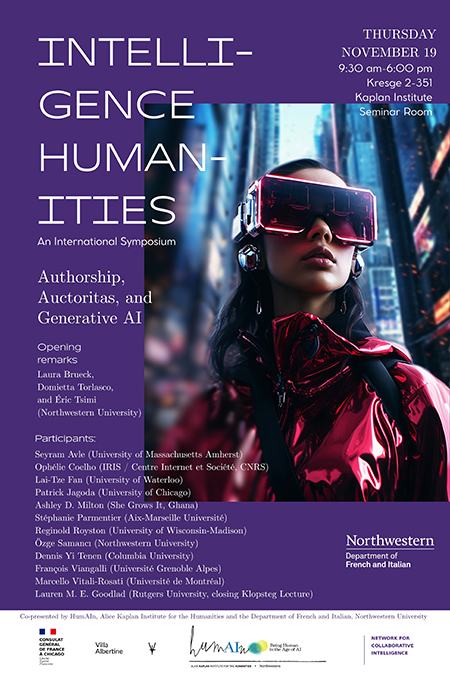 Artificial intelligence arrives with an older companion: the history of signs, authority, interpretation, and delegated intelligence. Today's systems write with unprecedented fluency, yet intelligence itself is hardly a settled premise; the sharper question belongs to the humanities: who has the authority to recognize it, interpret its signs, and decide when a generated form becomes knowledge, literature, or output without responsibility?
Presented by the Department of French and Italian and the Kaplan Humanities Institute's HumAIn Inititive, with support from the Weinberg Dean’s Office; Villa Albertine Chicago/The French Embassy of the United States; Northwestern Network for Collaborative Intelligence (NNCI); and the Office of the Provost through the Klopsteg Lecture Fund.
Winter 2027
Do Robots Have Souls? — Sylvester Johnson
January 27, 2027
5:00 - 6:30 pm
Location to be announced
Free and public welcome! This conversation is also a keynote of Kaplan Humanities Institute's Critical Conversations in the Humanities.
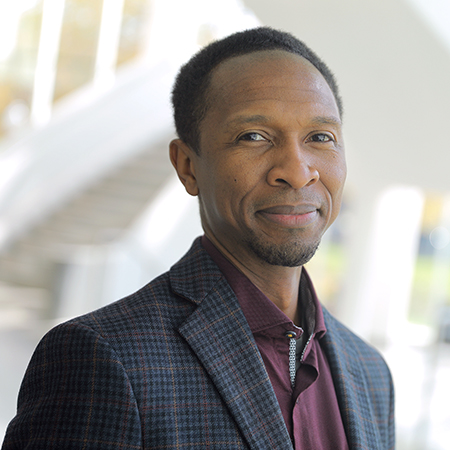 Sylvester Johnson is Professor of Black Studies at Northwestern. As a scholar of race, religion, and technology, he works at the intersection of technical and humanistic stakeholders to advance more democratic, inclusive outcomes for an innovation-driven society. Johnson leads the Future Humans, Human Futures project, which has been supported by the Henry Luce Foundation. This project engages the current and emerging challenges for ethical governance of technology by working across multiple societal sectors to cultivate socio-technical knowledge and skills. His forthcoming book examines classic questions about the difference (or not) between people and things within the context of computing and biotech—specifically new developments in artificial intelligence. Can a machine actually know anything? How does our material nature constitute our humanity? Our personhood? And what political consequences will result as people are increasingly combined with machines (e.g., for medical therapies)?
Spring 2027
We’re All Going to Be OK — Rayvon Fouché
Spring date and details to be announced!
Free and public welcome! This conversation is also a keynote of Kaplan Humanities Institute's Critical Conversations in the Humanities.
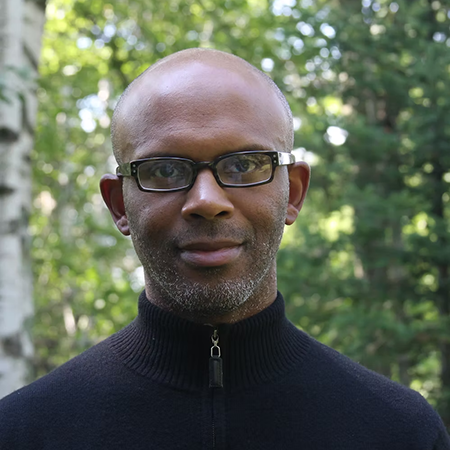 Rayvon Fouché is Associate Dean for Graduate Education and Professor of Communication Studies in Northwestern's School of Communication. He is also Professor of Journalism in the Medill School of Journalism, Media, and Integrative Marketing Communications, and serves as faculty in Northwestern's Science in Human Culture Program. His scholarship on invention and innovation explores the multiple intersections and relationships between cultural representation, racial identification, and technoscientific design. He directs the Humanity and Technoscience (HAT) Lab which aims to create a collaborative space for researchers from a variety of backgrounds and scholarly disciplines to examine how science and technology impact and interact with humanity. HAT Lab studies the material implications—the histories, the politics, and the uses—of science and technology to produce research that explains the ways past, present, and future societies shape and are influenced by our world’s technoscience.