
Spring 2027 Global Humanities Lab
Mediterranean Crossroads: Researching Mobility in Southern Italy
HUM 310-0 / RELIGION 278-0
Fulfills FD-LA / Literature and Arts
Instructor: J. Michelle Molina, Associate Professor in Religious Studies and Affiliate Faculty in History
- This is a spring course on campus in Evanston, preceded by field research travel to Puglia, Italy during spring break
- This course is open to sophomores, juniors, and seniors
Course description
Mediterranean Crossroads: Researching Mobility in Southern Italy
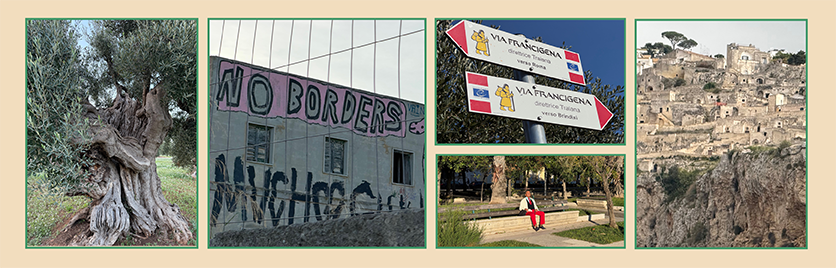
Step into the living history of the Mediterranean with this immersive, research-driven experience in Puglia, Italy. More than a study abroad trip, this Kaplan Global Humanities Lab invites students to explore how people, ideas, goods, and cultures move across regions and shape local communities. Through visits to archaeological sites, pilgrimage routes, museums, olive groves, and migrant education programs, students will investigate questions spanning migration, religion, environment, architecture, and global exchange. You'll walk sections of the historic Via Francigena, encounter the iconic trulli dwellings of Puglia, learn from local experts, and engage directly with communities navigating contemporary challenges such as migration and ecological change. Along the way, you'll develop your own original research project rooted in firsthand observation and experiential learning. Ideal for curious students interested in the humanities, social sciences, history, culture, and global studies, this course offers a unique opportunity to connect local stories to larger global processes while building research, observation, and critical thinking skills.
This course begins over spring break 2027, when we will travel to Puglia, Italy.
Course enrollment
Course enrollment is by application only—see instructions below. Students must attend the 2027 spring break field research trip and complete the corresponding quarter-long course to receive full course credit.
Costs and financial aid
Roundtrip airfare from Chicago, as well as shared room lodging, meals, activity fees, and ground transportation will be provided directly by Northwestern. Students will be responsible for covering the costs of passports, travel visas, incidentals, and other expenses associated with the trip.
Required travel documents
Students must have a valid passport to make this trip. The passport must be valid for at least six months beyond the end date of the trip. Students are responsible for obtaining any special documents or permissions (i.e., Electronic Travel Authorizations, standard visas, etc.) required for travel in and out of the United States and to any Global Humanities Lab destinations.
Commitment to the course
Please note that the Kaplan Institute considers the act of applying to this course a binding commitment to participate in the spring break class trip and the corresponding spring quarter course. If a participant is accepted and enrolls in a Global Humanities Lab course and later drops, or drops out of the trip—except under extreme medical circumstances—that student will be responsible for reimbursing costs related to their travel, including airfare, lodging, and any other related expenses.
How to apply
The deadline to apply for this course is Friday, October 30, 2026. We will inform applicants of decisions by November 13. If you are accepted into the course, we will provide you with a permission number to enroll in the course.
In the application portal, please complete all fields including the names and email addresses of two (2) Northwestern faculty references. NOTE: for the faculty references, a letter is not needed, though the committee may email the faculty member to ask them a question about your engagement in class. You will also be asked to submit the following application documents:
- Current resume or CV
- Unofficial Northwestern transcripts
- A personal statement (500 words or less) that: 1) explains why you are interested in the overall course; 2) explains one particular aspect of the course that interests you and why; and 3) explains how this course topic fits into your trajectory as a student at Northwestern, in your future plans, and/or as part of your broader interests as a curious person.
- A short response (500 words or less) to the following: Travel can throw one off kilter in ways both frustrating and revealing. To deepen our engagement with all Puglia has to offer, technology will take a backseat on this study trip. Instead, required modes of engagement will include taking hand-written notes and engaging in a sketchbook drawing practice (with a short set of instructions each day, no need to have ever drawn prior). You will have the opportunity to use film photography to document our class time together should you wish to take pictures. In sum: there will be extended periods each day when you will be required to leave your phones, iPads, and other smart devices in the car. Computers are not prohibited: you can transfer your written notes to your computer at the end of the day, but this will happen on your own time. In our group settings, we will be present to one another and the natural and material worlds we are there to explore. Do you expect this requirement to be frustrating, revealing, or maybe some of each?
Application link
Criteria for selection
Criteria for selection include qualities of intellectual curiosity, academic excellence, and maturity. This opportunity is open to sophomore, junior, and senior undergraduates in any major. Decisions will be made by the instructor and Kaplan review committee.