
Critical Conversations in the Humanities
To see more 2026-2027 lectures and dialogues at Kaplan, click here: https://humanities.northwestern.edu/about/events/2026-2027-dialogues-and-lectures.html
The Kaplan Critical Conversations in the Humanities keynotes invite scholars to address timely topics of wide interest or urgency from a humanistic perspective.
FALL 2026
Scenes of Error — Sianne Ngai
October 21, 2026
5:30 - 7:00 pm
Harris Hall #108
Free and public welcome!  Through meditations on Hegel, "dramatism," and the images of visual artist Ebecho Muslimova, this talk explores the affective dimensions of dialectical thinking, especially as the latter involves the risky act of staging and lingering in scenes of error.
About Sianne Ngai
Sianne Ngai is George M. Pullman Distinguished Service Professor in the Department of English Language and Literature at the University of Chicago. Ngai’s first book, Ugly Feelings (2005, Harvard University Press), is considered a key work of affect theory for its focus on politically ambiguous, non-cathartic negative emotions—envy and irritation as opposed to anger and fear. Her second book, Our Aesthetic Categories: Zany, Cute, Interesting (2012, Harvard University Press), which won the Modern Language Association’s James Russell Lowell Prize, argues for the contemporary centrality of three everyday aesthetic categories, which are approached with the same philosophical seriousness given to the beautiful and sublime. Ngai’s most recent book, Theory of the Gimmick: Aesthetic Judgment and Capitalist Form (2020, The Belknap Press of Harvard University Press), a Christian Gauss Award finalist, co-winner of the ASAP Book Prize, and a Literary Hub Book of the Year, explores the “gimmick” as a speech act and form encoding a series of interconnected contradictions concerning labor, time, and value. Extending Ngai’s previous investigation of the rise of equivocal aesthetic judgments (such as the merely “interesting”), Theory of the Gimmick explores the uneasy mix of attraction and repulsion produced by the gimmick across a range of forms specific to capitalist culture. Ngai’s work is most broadly concerned with the analysis of aesthetic forms and judgments specific to capitalism. She is currently working on Ugly Thinking, a book about the affective dimensions of dialectical thought and the ways in which Marx, Hegel, and a number of writers and artists inhabit error.
FALL 2026
Daniel Mendelsohn - THE ODYSSEY—A New Translation
November 16, 2026
4:00 - 5:30 pm
Guild Lounge (in Scott Hall, 601 University Place)
Free and public welcome!
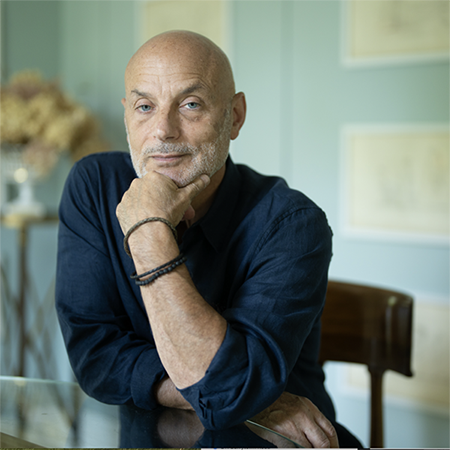 The Kaplan Humanities Institute welcomes Daniel Mendelsohn to discuss his recently published new translation of THE ODYSSEY (University of Chicago Press 2025).
About Daniel Mendelsohn
Daniel Mendelsohn is an internationally bestselling author, critic, essayist, and translator. Born in New York City in 1960, he received degrees in Classics from the University of Virginia and Princeton. After completing his PhD he moved to New York City, where he began freelance writing full time; since 1991 he has been a prolific contributor of essays, reviews, and articles to many publications, most frequently The New Yorker and The New York Review of Books. He has also been a contributing editor at Travel + Leisure and a columnist for The New York Times Book Review, Harper’s, and New York magazine, where he was the weekly book critic. In February 2019, he was named Editor-at-Large of the New York Review of Books and the Director of the Robert B. Silvers Foundation, a charitable trust that supports writers of nonfiction, essay, and criticism.
Mendelsohn’s books include An Odyssey: A Father, a Son, and an Epic (2017), named a Best Book of the Year by NPR, Newsday, Library Journal, The Christian Science Monitor, and Kirkus; The Lost: A Search for Six of Six Million (2006), which won the National Books Critics Circle Award and the National Jewish Book Award in the United States and the Prix Médicis in France; a memoir, The Elusive Embrace (1999), a Los Angeles Times Best Book of the Year; three collections of essays; a scholarly study of Greek tragedy, Gender and the City in Euripides’ Political Plays (2002), and a two-volume translation of the poetry of C. P. Cavafy (2009), which included the first English translation of the poet’s “Unfinished Poems.” His tenth book, Three Rings: A Tale of Exile, Narrative, and Fate, published in September 2020, was a Kirkus Best Book of the Year and a Literary Hub Favorite Book of 2020, and was named Best Foreign Book of the Year in France.
 The Winter and Spring Critical Conversations are also part of the Kaplan Humanities Institute's initiative: HumAIn: Being Human in the Age of AI, a new series of conversations and keynotes, a book club, conferences, and curriculum development opportunities at Northwestern.
Winter 2027
Sylvester Johnson - Do Robots Have Souls?
January 27, 2027
5:00 - 6:30 pm
Location to be announced
Free and public welcome!
Sylvester Johnson is Professor of Black Studies at Northwestern. As a scholar of race, religion, and technology, he works at the intersection of technical and humanistic stakeholders to advance more democratic, inclusive outcomes for an innovation-driven society. Johnson leads the Future Humans, Human Futures project, which has been supported by the Henry Luce Foundation. This project engages the current and emerging challenges for ethical governance of technology by working across multiple societal sectors to cultivate socio-technical knowledge and skills. His forthcoming book examines classic questions about the difference (or not) between people and things within the context of computing and biotech—specifically new developments in artificial intelligence. Can a machine actually know anything? How does our material nature constitute our humanity? Our personhood? And what political consequences will result as people are increasingly combined with machines (e.g., for medical therapies)?
Spring 2027
Rayvon Fouché - We’re All Going to Be OK
Spring date and details to be announced!
Free and public welcome!
Rayvon Fouché is Associate Dean for Graduate Education and Professor of Communication Studies in Northwestern's School of Communication. He is also Professor of Journalism in the Medill School of Journalism, Media, and Integrative Marketing Communications, and serves as faculty in Northwestern's Science in Human Culture Program. His scholarship on invention and innovation explores the multiple intersections and relationships between cultural representation, racial identification, and technoscientific design. He directs the Humanity and Technoscience (HAT) Lab which aims to create a collaborative space for researchers from a variety of backgrounds and scholarly disciplines to examine how science and technology impact and interact with humanity. HAT Lab studies the material implications—the histories, the politics, and the uses—of science and technology to produce research that explains the ways past, present, and future societies shape and are influenced by our world’s technoscience.
Past Critical conversations in the humanities
Click HERE to view events from previous years.
Past Humanities Dialogue Series
- SOVEREIGNTIES Dialogue 2023-2024 - Bodily, artistic, intellectual, geopolitical
- ENERGIES Dialogue 2022-2023 - Personal, collective, planetary
- CARE Dialogue 2021-2022 - Care and its possibilities
- MEMORIALIZING Dialogue 2019-2020 - Commemorating, contesting, and claiming
- SECURITY Dialogue 2018-2019 - Struggles over security
- TRUTH Dialogue 2017-2018 - Knowledge crises and politics
- Debt Dialogue 2016-2017 - What does it mean to be indebted—politically, economically, artistically, ethically?
- PAST Dialogue Series (2010-2016)
- PAST Distinguished Harris Lectures
- PAST Public Humanities Lecture